|
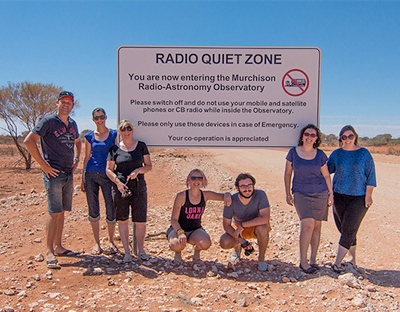
CSIRO test equipment at the MRO February 2007. Mr. Mark Halleen and Ms. Leonie Moore (DOIR) discussing the site with Mr. Shane Hill (member for Geraldton), Mr. Terry Burnage (DOIR) and Mr. John Richards. Radio Frequency Interference (RFI) testing equipment from CSIRO and the joint Australian-US MWA project was moved to the Murchison Radio-astronomy Observatory (MRO) in early January 2007. Following discussions between projects, the Western Australian Government Department of Industry and Resources (DOIR), the station manager and station lease holder, the centre of the 70 km radius circle defining the MRO was set at S26o42’15”, E 116o39’32”. The MRO will be protected from developments that may cause radio interference through a combination of special WA State legislation and exiting Federal legislation administered by the Australian Communications and Media Authority. This site is 76km south west of Mileura homestead, 79km from the western end of the Weld Range and 93km from the current Jack Hills mining site. The MRO will be home to the two main projects forming the Australian SKA Pathfinder [ASKAP] – the CSIRO-ATNF/Canada large-N, small-d Array [formerly xNTD/MIRANdA] and the joint US/Australian/Indian Murchison Widefield Array [MWA, formerly MWA-LFD]. Several smaller experiments (CORE, PAPER and SCOPE) will also be sited at MRO. A joint taskforce formed between CSIRO and WA government will define and establish essential infrastructure for MRO to enable the first hardware for MWA to be installed by the end of 2007. Images
These images were collected on 12 April 2007 by Karen Haines, Peter Morse and Lister Staveley-Smith. Image processing by Paul Bourke. Please contact Paul Bourke (WASP) if you would like higher resolution or stereoscopic images. A joint WASP/Communication Studies/Physics project of the University of Western Australia. COPYRIGHT: University of Western Australia SimulationsSome of the above aerial photography of the MRO were used by Paul Bourke (WASP) as a backdrop for generating simulated flybys of the ASKAP and MWA32T arrays. Here are the low-resolution 'pre-production' mono versions:
CREDIT: Paul Bourke (Western Australia Supercomputer Program) COPYRIGHT: University of Western Australia |